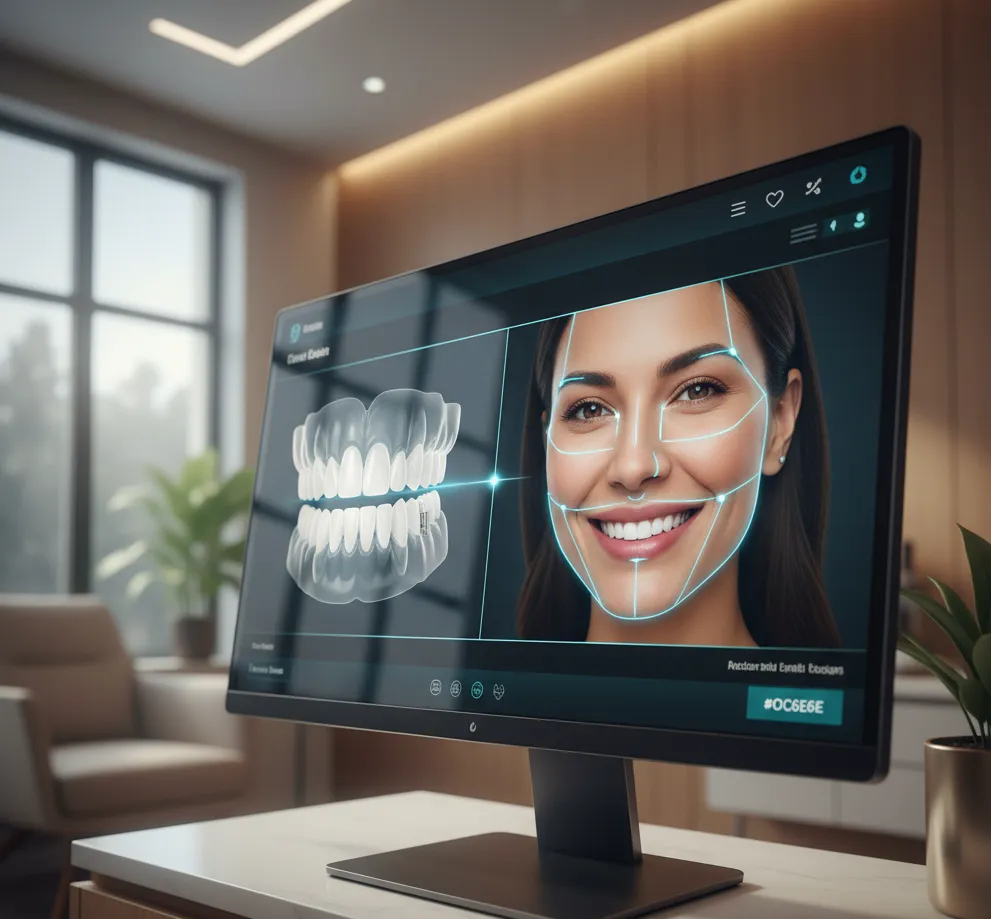
Digital Smile Design builds a model of your teeth against your face from photographs and a scan, so the changes are proposed on a screen first. Seeing a design is not agreeing to treatment.
What you actually see
It starts with photographs and a scan. Photographs of your face at rest, talking and smiling, and a digital scan of your teeth. Those two things are combined into one model, so your teeth are measured against your face rather than on their own. That is the part that does the work. How wide a tooth should be, the line your upper teeth follow when you smile, how much of them shows when you talk, where the middle sits against your nose and your eyes — none of it can be judged from a model of teeth sitting on a bench.
Changes are then proposed on that model instead of on your teeth. Length, width, shape, shade, the position of the edges. You look at the proposal on a screen next to how things look now and say what you think. If something reads as too long, too bright or too even, it is changed on the model and you look again. Treat what you see as a plan rather than a photograph of your future.
The design is not built while you wait, so you typically see it at a later visit rather than the one where the photographs were taken. Many patients find that second appointment is the one that settles the question in either direction. Looking at a proposal is a different experience from imagining one.
Nothing has happened to a tooth at any point in that. It is the whole reason for planning this way. Veneers and most cosmetic work involve changes to enamel that cannot be reversed, so the decisions are worth making while they are still only decisions. Dr. Abdoun writes about the approach here.
What it commits you to
A design is a proposal. Looking at one does not book anything, does not commit you to veneers, aligners or whitening, and does not oblige you to go ahead at all. People regularly look at a plan and decide they want less than they first imagined, or that the timing is wrong for them this year. Both are ordinary outcomes here and neither is a problem. The design exists so the decision is an informed one, and an informed decision includes the option of not doing it.
It also does not suit every case. Sometimes the answer after the exam is that one tooth needs repairing rather than a smile needing designing. Working that out is what the first conversation is for, so start there rather than with a treatment plan. Call the office and tell us what bothers you about your smile.
The photograph further down this page shows planning software running on a monitor. It is not a patient of this practice. We do not publish patient photographs.

Digital Smile Design is a planning method rather than a treatment. Photographs of your face and a digital scan of your teeth are combined into one model, so proportions are judged against your features instead of on their own. Proposed changes to shape, length, shade and alignment are made on that model and shown to you on a screen. You give an opinion, the design is adjusted, and only then does anyone discuss starting. It is a way of making the decision while it is still only a decision.
We photograph your face at rest, talking and smiling, and take a digital scan of your teeth. The photographs are what let us judge your teeth against your face rather than on their own.
Your images and scan are combined into one model, and changes to shape, length, shade and alignment are proposed on it. This happens between appointments rather than while you wait.
You see the proposal next to how things look now, typically at a later visit. If something reads as too long, too bright or too even, it is changed on the model and you look again.
Once the design is one you are happy with, it becomes the reference the treatment is planned around. No irreversible work is done to a tooth before that point.
You see a proposal before any enamel is changed
Proportions judged against your own face, not against a template
Your opinion is built into the design rather than collected afterwards
One plan that carries across veneers, aligners and implant cases
We plan cosmetic work this way because most of it involves changes to a tooth that cannot be reversed. A decision made against something you can look at is a better decision than one made against a description, and it gives you a real chance to say no, or to say less, before anything starts. Design planning does not suit every case, and part of the consult is working out whether it suits yours. If it does not, we will tell you what would.
Schedule a consultation to discuss your options and see if this treatment is right for you.