Maybe your front teeth look shorter than they used to, and the edges have gone thin and see-through. A molar cracked last year, then another, and each repair seems bigger than the last.
If you are looking into a full mouth restoration in Stafford, it can sound like All-on-4, where implants replace every tooth in an arch. If you still have most of your own teeth, that is usually not where the conversation starts. A full-mouth restoration can rebuild the teeth you already have, and the plan starts with your bite.
Let me walk you through what that involves and how to tell whether your teeth are worth keeping.
What does a full-mouth restoration involve if you still have your teeth?
A full-mouth restoration rebuilds most or all of the teeth in both jaws as one plan, instead of one tooth at a time. When you keep your own teeth, it uses the same materials as a single repair. Composite bonding adds tooth-colored material where enamel has worn away, and an onlay covers the chewing surface of a back tooth. A crown wraps a tooth that has lost too much to hold together alone, and a veneer covers the front of a front tooth.
What changes is the planning: the dentist designs each tooth against its neighbors and against the teeth it meets in the other jaw. The same plan replaces any tooth too damaged to keep, using a bridge or a dental implant. All-on-4 suits an arch where few or no teeth are worth keeping, and our All-on-4 guide covers it.
Why do teeth wear down all over the mouth?
Three processes wear teeth, and most worn mouths show more than one. Grinding and clenching rub tooth against tooth, while hard brushing scrubs from the outside. Acid from reflux, or from sipping soda, juice or sports drinks all day, softens the surface.
A European consensus statement on severe tooth wear notes that grinding removes very little measurable tooth unless acid has softened the surface first.
Wear can also speed up. Enamel, the hard outer layer, wears slowly, but once it wears through, the softer dentin underneath wears faster. That explains the yellow, hollowed edges that chip so easily: the thin rim of enamel around them has nothing behind it. The same consensus calls wear severe once dentin shows and a third or more of the visible tooth is gone.
Missing back teeth add another route. Without molars, the front teeth take chewing force the back teeth used to carry, and they wear, spread apart or crack.
Why does the plan start with your bite?
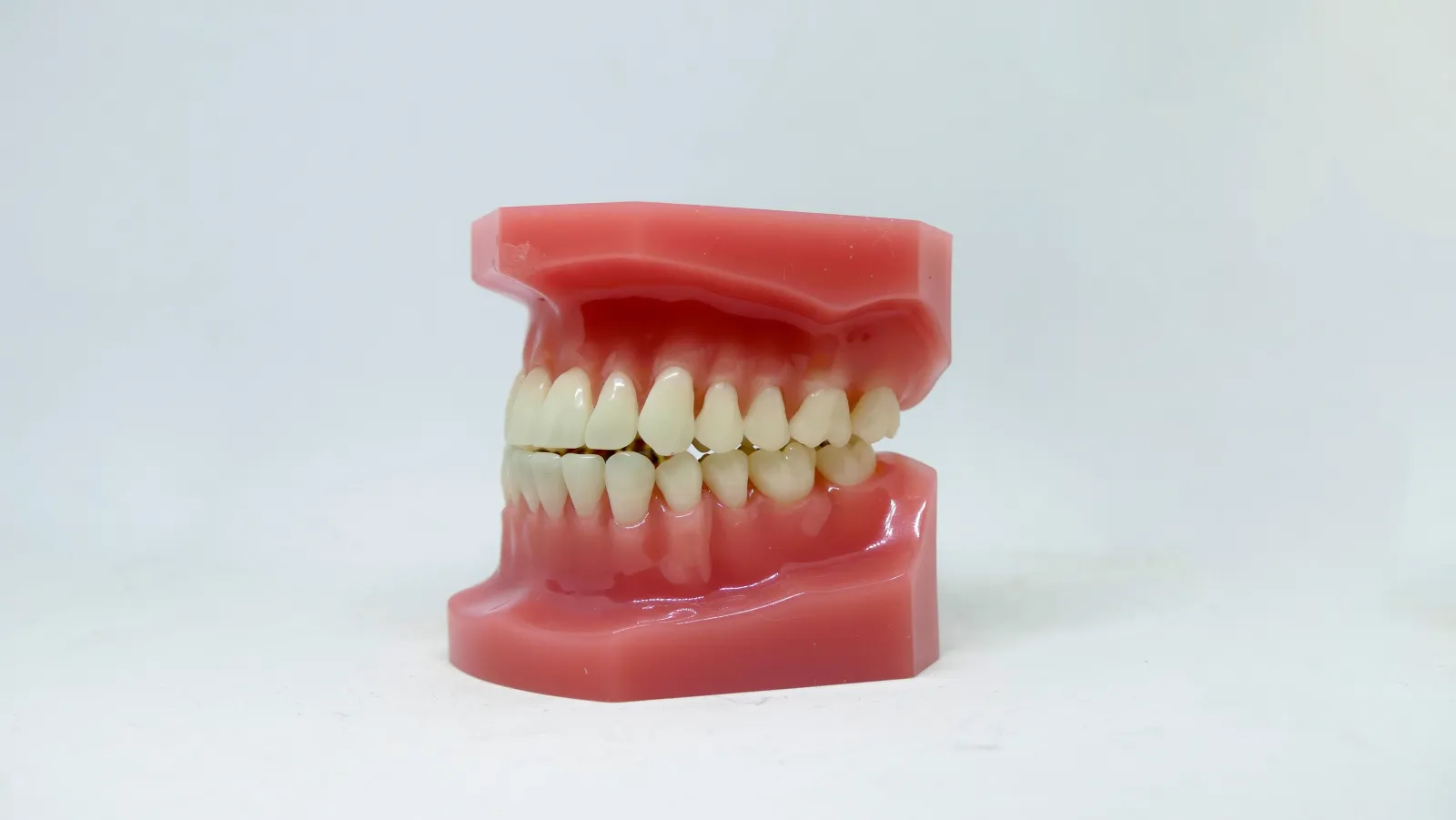
Your bite, also called the occlusion, is how your teeth meet when you close and where your jaw comes to rest. It decides where force lands on every tooth and every crown, and a repair that ignores it chips or comes loose.
As teeth wear down, they can keep meeting anyway, because a worn tooth slowly moves toward the opposite jaw to stay in contact. So the lost height is not empty room waiting for a crown. To fit new material, a dentist either removes more tooth or opens the bite slightly, so the jaw closes at a new, taller point.
The European consensus says a dentist may need to raise the bite this way to make room for restorations without cutting away sound tooth. A systematic review in Quintessence International concluded that raising the bite, where a case calls for it, is safe and predictable. The side effects it found settled on their own, though it said better-designed studies are still needed.
When the whole mouth is worn, repairing one tooth at a time runs into a problem. Each new crown has to fit its worn neighbors, so it copies the worn bite. Planning the whole mouth at once lets the dentist build every tooth to the same new bite.
If grinding caused the wear, the new teeth will meet the same force. The consensus notes that restorations do not stop wear, they only change its rate and where it happens. Grinding can also shorten the life of porcelain crowns and onlays. A plan for someone who grinds in their sleep can include a night guard.
Dr. Ezzat Abdoun is a Fellow of the Las Vegas Institute, where his training covered full-mouth rehabilitation and occlusion.
Who can rebuild their own teeth, and who needs to replace them?
Keeping a tooth depends on what sits below the gumline more than on how it looks above it. You are usually a candidate to rebuild when:
- the roots are solid in bone and the teeth are not loose
- your gums are healthy, or treatment can bring gum disease under control first
- enough tooth stands above the gumline for a crown or onlay to grip
- the cause of the wear, such as reflux or grinding, is under control
The consensus advises against final restorations while wear is still active, so that last point comes first.
Replacing makes more sense for a tooth that has broken or decayed below the gumline, or cracked down into the root. The same goes for teeth that gum disease has loosened by destroying the bone around them. A plan can also be a mix, rebuilding most teeth and replacing a few with an implant or a bridge.
For the teeth you keep, the consensus favors adding material, such as bonding, over cutting teeth down for crowns wherever the case allows. Bonding leaves a crown available later, while cutting a tooth down for a crown cannot be undone.
How is a full-mouth plan put together at our office?
Our Digital Smile Design page explains that designing helps most when a plan changes several teeth in ways that cannot be undone. The design starts with photographs of your face and a digital scan of your teeth, and you see the proposal on a screen. Seeing it commits you to nothing, and no irreversible work happens before you agree to it.
A lab makes the crowns, which usually takes about two weeks, and you wear temporary crowns in between.
After the exam, we give you the plan in writing, with the numbers on it. We verify your benefits with your plan, and we schedule nothing until you have read it. We can also phase the work, so the teeth that need attention most come first. If long appointments worry you, ask about sedation: we offer nitrous oxide, oral sedation and IV sedation.
Then the decision is yours, and rebuilding every tooth, replacing some, or starting with less than the full plan are all ordinary choices.
Common questions about full-mouth restoration
Is a full-mouth restoration the same as All-on-4?
No. All-on-4 replaces every tooth in an arch with a bridge fixed to four implants. A full-mouth restoration can take that form, but it can also rebuild the teeth you have with bonding, onlays, crowns and veneers. Which one fits depends on how many of your teeth are worth keeping.
Can worn teeth be rebuilt without crowns?
Sometimes, at least in part, because bonding and onlays add material and remove less tooth than a full crown does. Crowns still have a place where bonded repairs keep failing, or where large old fillings have weakened a tooth. The exam decides which teeth get which.
What should you do if your teeth are wearing down?
If your teeth keep breaking or your bite feels different than it used to, an exam shows which ones are worth keeping. Call us at (540) 288-2800 or send a message through our contact page.
More from Our Blog
Are Silver Fillings Safe, and Should You Have Them Replaced?
For most people, a silver filling in good condition is better left in place. The FDA advises against removing intact ones, because drilling them out raises mercury exposure for a while and costs healthy tooth.
Read more
A Black Spot on Your Tooth: Stain, Cavity, or Something Else?
A black spot on a tooth can be stain, tartar, an old filling, decay that has stopped, or a cavity that is still growing. Color is the weakest clue, so hardness, change over time and an X-ray tell them apart.
Read more
Can a Root Canal Make You Sick? Where the Myth Came From
The claim traces to 1920s rabbit experiments that other researchers could not repeat, and a later cancer study found no added risk. The danger is the infection inside the tooth, which a root canal removes.
Read more