Maybe a dentist has told you a tooth cannot be saved, or you have lived with a gap long enough. When you search for an implant dentist in Stafford, the pages that come back tend to sound alike. Many of them talk about experience and technology, which are hard to compare from the outside.
What you can compare is how a dentist answers a few plain questions. Let me walk you through five of them, and what each answer tells you.
Is an implant dentist a specialist?
No, and the reason is useful. The national commission that recognizes dental specialties, hosted by the American Dental Association, lists 12 of them, and implant dentistry is not on the list.
Oral surgeons, periodontists and prosthodontists all work with implants, each from a different specialty. So do general dentists who completed extra implant training after dental school. The words "implant dentist" describe a focus of someone's work, not a qualification.
So ask two things instead: where the dentist trained in implants, and how often they place and restore cases like yours. One implant in thick bone and a full arch on four implants are different jobs, so experience with one does not answer for the other.
Who places the implant, and who makes the tooth?
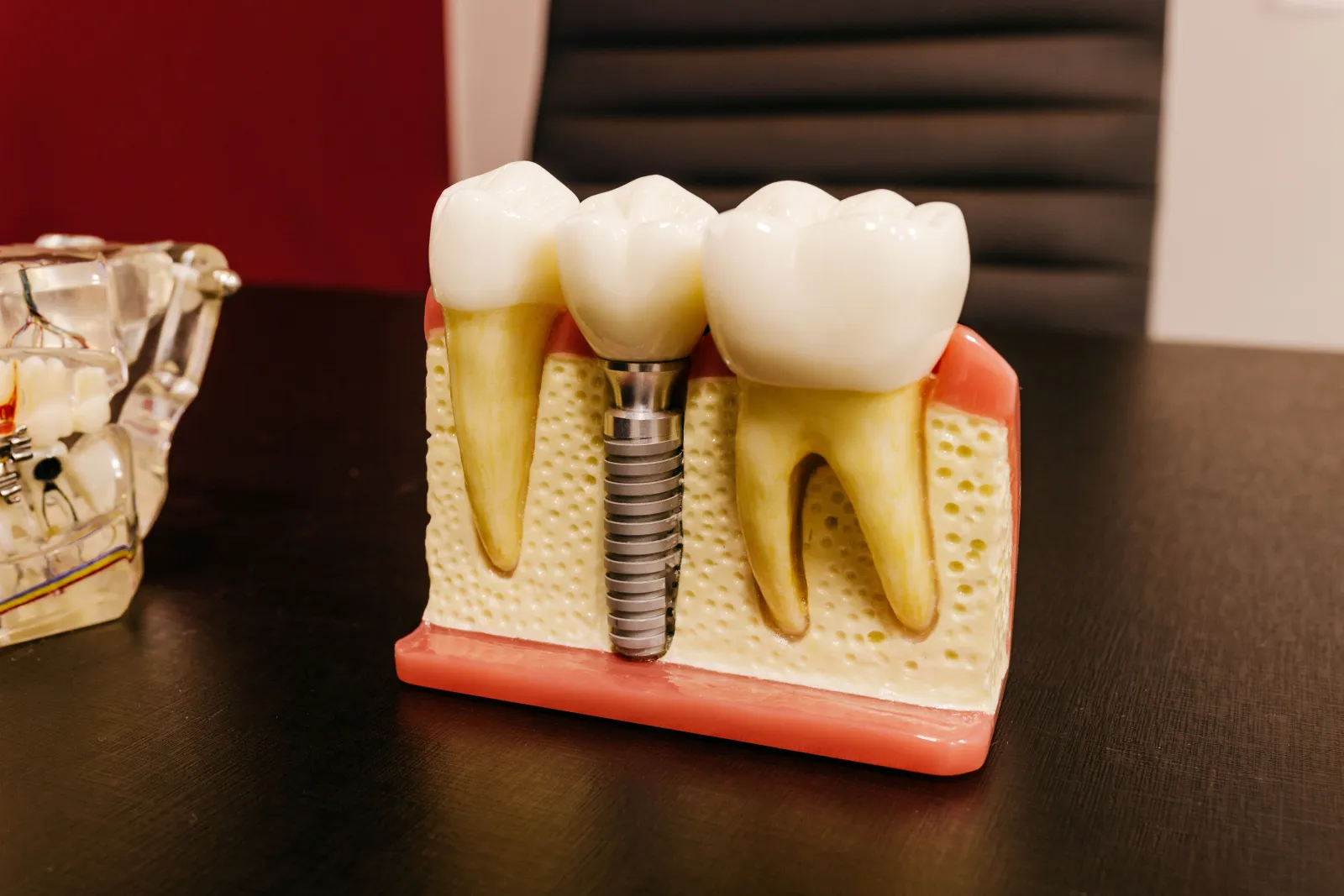
An implant is two jobs. The first is surgical, when a titanium post goes into the jawbone. The second is restorative, when a small connector called an abutment joins a crown to that post.
The two jobs depend on each other because of how an implant heals. Over the weeks after surgery, bone grows onto the implant's surface, a process called osseointegration. Our post on the single implant timeline explains that stage. Once the bond forms, the implant stays exactly where it was placed, and the crown has to be built on that position.
Picture an implant that went in tilted toward the cheek. The crown on top then has to bulge outward to line up with your other teeth, or sit off the line of your bite. A bulging crown traps plaque where the brush does not reach, and a crown off the line of your bite takes force at an angle.
That is why careful planning starts from the tooth, not the bone. The dentist decides where the finished crown should sit, then places the implant underneath it. In many places, a surgeon places the implant and a second office makes the crown. That can work well, but the plan has to travel between two offices. Ask who designs the final tooth, and whether that happens before surgery.
How will my implant be planned?
A regular dental X-ray is a flat picture, so it shows the height of the bone but not its thickness from cheek to tongue. That thickness decides whether an implant fits, and how wide it can be.
A cone beam CT (CBCT) scan is a 3D scan of the jaw that measures this thickness. It also shows the nerve that runs through the lower jaw and the sinus above the upper back teeth. The American Academy of Oral and Maxillofacial Radiology recommends this kind of 3D imaging for every implant site. Its 2012 position statement names CBCT as the method of choice for it.
With the scan, the implant can be planned on a screen before surgery. On some cases, a printed surgical guide then fits over the teeth and steers the drill to the planned angle and depth. Not every case needs one, so ask whether yours does, and why.
What happens if the implant fails?
Implant failure is uncommon, and the research puts a number on it. A 2012 systematic review in Clinical Oral Implants Research pooled 46 studies of single implants carrying a crown. About 97% of the implants were still in place after five years, and the authors estimated about 95% at ten.
The crowns needed more attention than the implants under them. After five years, the screw holding the crown had come loose in about 9% of cases. At ten years, about 89% of the crowns were still in place. A loose screw or a chipped crown is a restorative repair, so it helps to know which office you will go back to.
When a dentist quotes a success rate, ask what it counts. The 97% in that review measures survival, meaning the implant was still in the mouth. Problems were counted separately. By five years, about 5% of the implants had lost more than 2 mm of the bone around them.
Researchers proposed stricter criteria for success in 1986, and a 2013 review lists them. Those also require no movement, no lasting pain or infection, and limited bone loss around the implant.
When an implant does fail, it usually happens in one of two ways. Early on, the bone may never bond to it, often because it moved or became infected while healing. Years later, inflammation in the gum around it can wear away the bone holding it.
Either way, the implant usually comes out and the site heals, and sometimes a bone graft comes before a new implant. Ask before surgery what that would involve and how it would be charged.
What should you ask an implant dentist in Stafford?
Five questions cover most of what you need to know before surgery:
- Training: Where did you train in implants, and how often do you treat cases like mine?
- Who does what: Will the same office place the implant and make the crown, and who designs the tooth?
- Planning: Will I have a 3D scan, and will a surgical guide be used in my case?
- Problems: What happens if the implant does not bond, and who sees me for a loose crown later?
- Cost: Will I get the plan in writing, with the numbers on it, before anything is booked?
The same logic applies to removing a tooth before an implant. Our post on whether an oral surgeon or a dentist should remove your tooth explains what on an X-ray sends a case to a surgeon.
How do our doctors answer these questions?
Our four doctors are general dentists. Three of us went on to train in implants after dental school, and here is where.
Dr. Ezzat Abdoun completed the implant program at Columbia University College of Dental Medicine. He is a Fellow of the International Congress of Oral Implantologists (ICOI), and full-arch work and single implants are a focus of his practice.
Dr. Mohamed Arafa completed a general dentistry residency and fellowship at Columbia and New York Presbyterian, where he was Chief Resident. He has more than 500 hours of training in implant dentistry and minor oral surgery.
Dr. Yasser Khedr completed a general dentistry residency at Nova Southeastern University and is also an ICOI Fellow. He has practiced in Northern Virginia since 2010.
We place implants and restore them in the same office. Our dental implants page covers the options, from one tooth to a full arch. A 3D scan is a standard part of assessing an implant case here. Our digital implant planning page explains which cases also get a printed guide.
After the exam and the scan, you get the plan in writing, with the numbers on it. We verify your benefits with your plan, schedule nothing until you have read it, and can phase the treatment. If a surgery visit worries you, we offer nitrous oxide, oral sedation and IV sedation.
Bring this list with you and ask us every question on it. To book a consultation, call us at (540) 288-2800 or send us a message.
More from Our Blog

Snap-In Dentures or Fixed All-on-4: How to Choose
A snap-in denture clips onto implants and comes out at night, and your gums still carry part of each bite. A fixed All-on-4 arch stays in and rests entirely on its implants.
Read more
What Is a Full-Mouth Restoration? It Isn't Always Implants
A full-mouth restoration does not always mean implants. When your own teeth are worn or broken but their roots are sound, they can be rebuilt with bonding, onlays and crowns, planned around your bite.
Read more
Are Silver Fillings Safe, and Should You Have Them Replaced?
For most people, a silver filling in good condition is better left in place. The FDA advises against removing intact ones, because drilling them out raises mercury exposure for a while and costs healthy tooth.
Read more