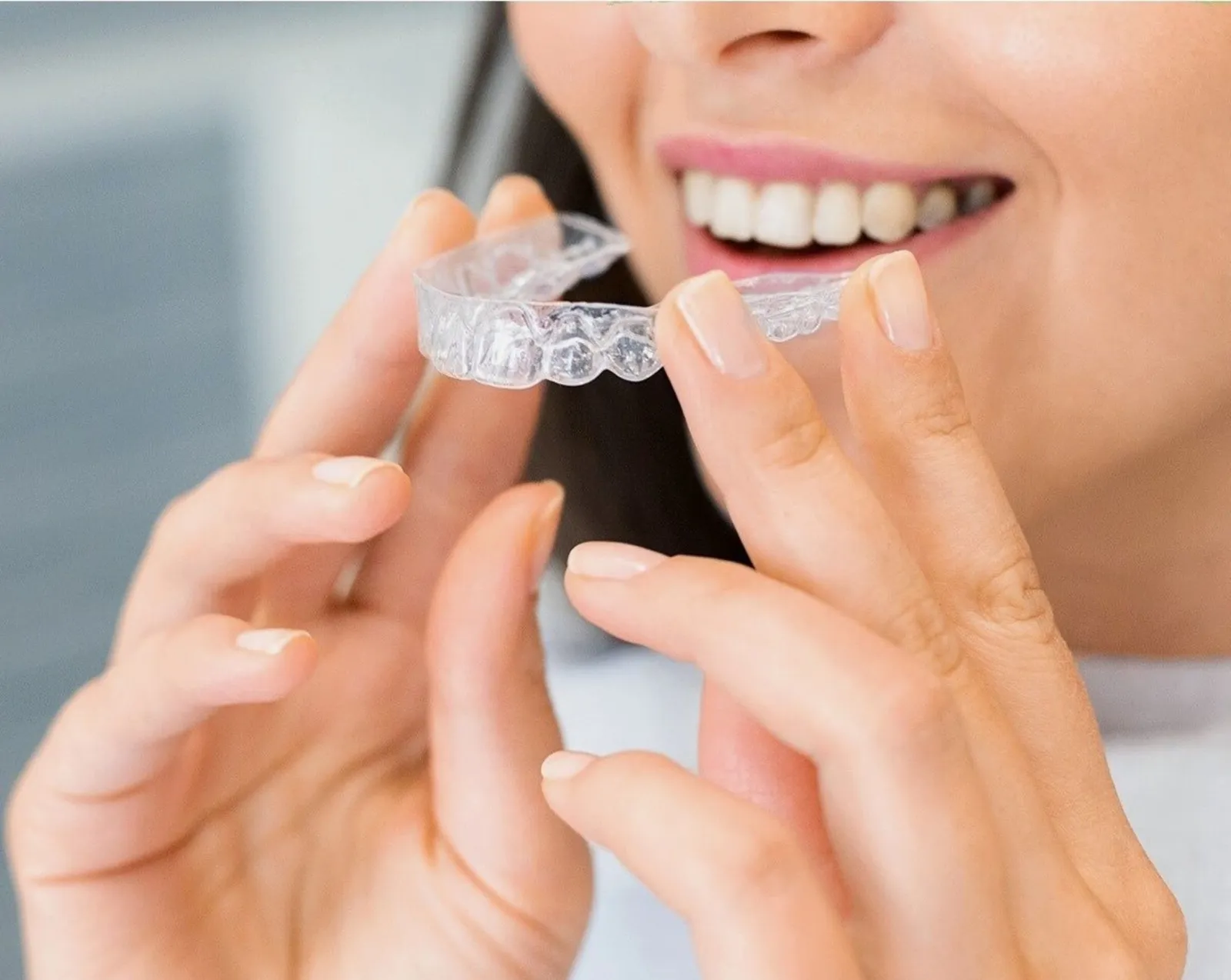
If you have searched Invisalign treatment cost, you have probably seen one national range stretching across several thousand dollars. Then two offices quote you numbers that do not match, and it is not always clear where the difference comes from.
The range is wide because an aligner quote is not the price of one product but a sum of parts. Each part tracks something about your teeth or your plan, and once you know the parts you can read any quote, including ours.
Why does Invisalign treatment cost vary so much between cases?
The biggest driver is how far your teeth need to move.
Each tray moves a tooth only a small step, because your body has to dissolve bone ahead of the root and rebuild it behind. That remodeling runs at its own pace, and how clear aligners move teeth covers it in detail.
So distance turns into trays. A front tooth that needs a slight shift takes a handful of steps. Closing wide spaces, or changing how the top and bottom teeth meet, takes many more. More trays mean more months, and more check-ins along the way.
Direction matters as much as distance. Tipping a tooth is the easiest movement for a plastic tray. Turning a rounded tooth is harder, because a smooth curved surface gives the tray little to push against.
That is what attachments are for. They are small tooth-colored bumps bonded to some teeth so the tray has something to grip. A case with many rotations usually needs more of them.
What are refinements, and why do they change the price?
A tray set is a prediction, and teeth do not always follow it exactly.
A 2020 study in the American Journal of Orthodontics and Dentofacial Orthopedics measured 38 patients treated with Invisalign. On average, their teeth reached 50% of the movement planned for them. Rotation was the least accurate movement, at 46%. One rotation of the upper canine, the pointed tooth at the corner of the mouth, reached only 37%.
That gap is why many cases need refinements, where a fresh scan produces a new set of trays for the movement that is still left.
Wear time feeds into this too. A tray left out for long stretches lets teeth drift back, so the next tray stops seating properly and the case falls behind its plan.
This is the part of a quote most worth reading closely. Ask whether refinements are included and how many, because a quote that covers only the first tray set can grow later.
What goes into planning before the first tray?
Before anything is made, the case needs records: usually a 3D scan of your teeth and bite, photographs, and X-rays.
Each one answers a different question. The scan shows where the crowns of your teeth sit and how they meet. X-rays show what a scan cannot see: the roots, and the bone holding them. A short root, or bone already lost to gum disease, limits how far a tooth can safely travel.
So records sometimes turn up work that has to come before the aligners, such as treating gum disease first. That work is usually quoted separately. Finding it at the start means the aligner plan is built around it, rather than paused halfway through while it is treated.
We plan clear aligner treatment from a 3D scan of your bite, and our clear aligner page walks through each step.
Why do retainers belong in the price if they come afterward?
Retainers are often missing from a first quote, and they are what keeps the result you paid for.
When the trays stop, the bone and soft tissue around each root have not finished settling. The American Association of Orthodontists says teeth will try to return to their original positions once the pressure stops. It also says you will wear retainers to some degree for the rest of your life.
Without them, teeth drift back toward where they started. That drift is called relapse, and correcting it often means paying for a second round of aligners. Teeth also keep shifting slowly with age, which why teeth shift as you get older explains.
Retainers also wear out, crack and get lost, so ask whether the first set is in the quote and what a replacement costs.
How does orthodontic insurance usually pay for aligners?
Orthodontic coverage works differently from the rest of a dental plan.
The American Dental Association's introduction to dental benefits describes a typical plan design. In that design, orthodontics is covered at 50% up to a separate lifetime maximum, set at $1,000 in its example.
Two things follow from that. The benefit stops at a fixed dollar amount, whatever the case costs. And a lifetime maximum does not reset each year, so once it is used on that plan, it is gone.
Plans differ on the details, so read the orthodontic section of yours for three things. Check whether it covers adults, whether it covers clear aligners, and how much of the lifetime maximum is left.
We verify your benefits with your plan rather than guessing from the card, and insurance and payment explains how that works.
What happens when you ask us about clear aligners in Stafford?
We provide clear aligner treatment here, and we do not place braces. We are general dentists providing aligner therapy, so if your exam and X-rays show your case needs braces, we will tell you and refer you. Clear aligners vs braces explains how that call is made.
Your number depends on your records, so it comes after the exam as a written plan showing expected coverage and your balance. Nothing is scheduled until you have read it, and you can ask about payment options while we go through the plan together.
What should you ask about any aligner quote?
Whether a quote comes from us or from another office, these questions break one number back into its parts:
- How many trays does the plan expect, and over how many months?
- Are refinements included, and if so, how many rounds?
- Are the records, the attachments and the check-in visits all included in the price?
- Is the first set of retainers included, and what does a replacement set cost?
- How much of my orthodontic lifetime maximum is still available to use?
To start with your own records, call us at (540) 288-2800 or send a message through the contact page.
More from Our Blog

Snap-In Dentures or Fixed All-on-4: How to Choose
A snap-in denture clips onto implants and comes out at night, and your gums still carry part of each bite. A fixed All-on-4 arch stays in and rests entirely on its implants.
Read more
What Is a Full-Mouth Restoration? It Isn't Always Implants
A full-mouth restoration does not always mean implants. When your own teeth are worn or broken but their roots are sound, they can be rebuilt with bonding, onlays and crowns, planned around your bite.
Read more
Are Silver Fillings Safe, and Should You Have Them Replaced?
For most people, a silver filling in good condition is better left in place. The FDA advises against removing intact ones, because drilling them out raises mercury exposure for a while and costs healthy tooth.
Read more