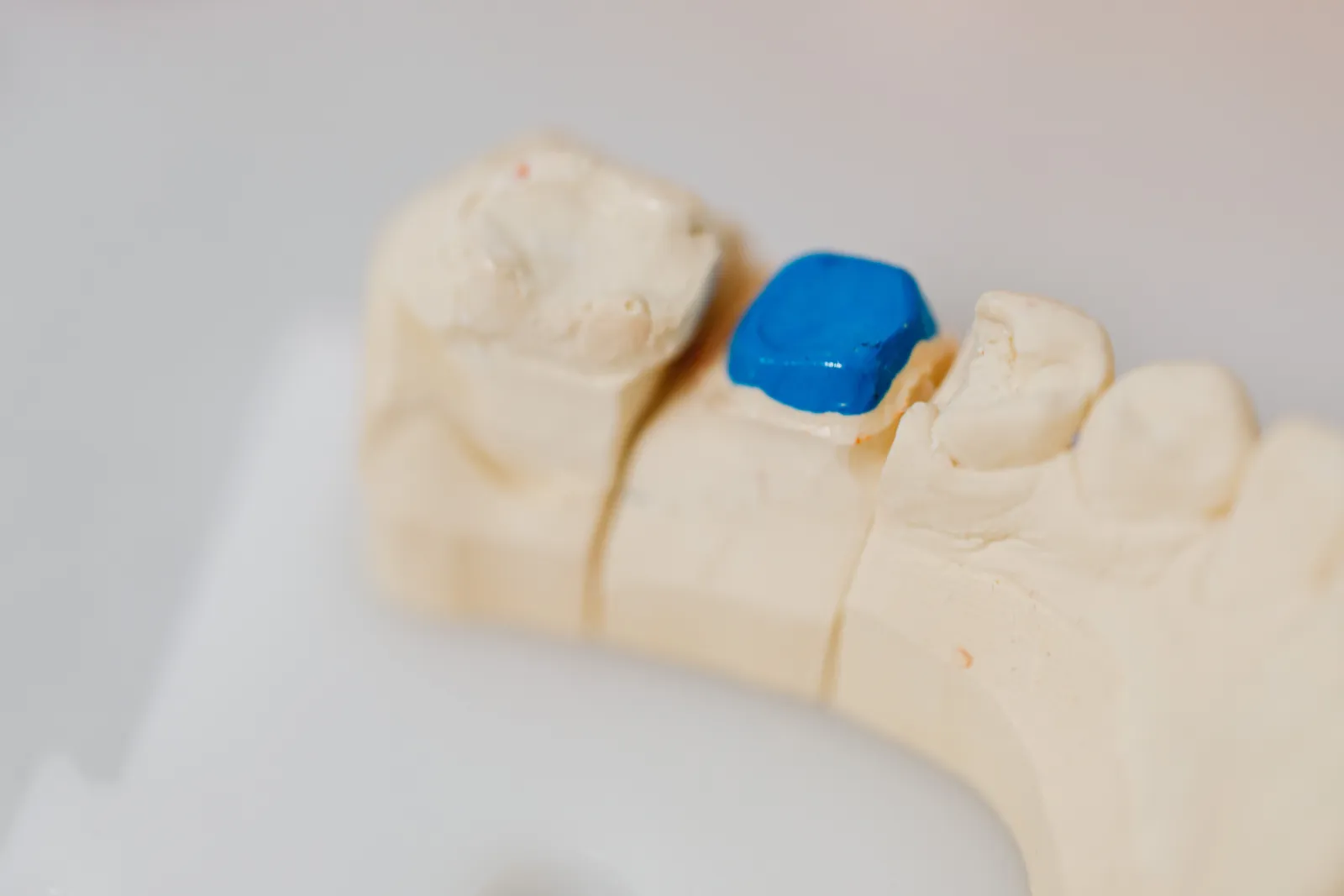
If you have searched how much a dental crown costs, you probably found national ranges too wide to tell you much about your own tooth. Or two offices quoted the same tooth, and the numbers did not match.
Both can be honest, because a crown fee is not the price of one object. It is a sum of parts, and each part tracks something about your tooth, the material, or your plan. Once you know the parts, you can read any quote, including ours.
How much does a dental crown cost, and why is there no single number?
The tooth itself shapes the fee before the material does.
A crown is a cap that covers a tooth that can no longer hold together on its own. Our dental crowns guide covers when a tooth reaches that point and how the crown is made. For cost, the question is what has to happen to the tooth before the crown can go on.
So a quote for "a crown" can describe very different jobs. One tooth needs shaping, a scan and a cap, while another needs its missing walls rebuilt first. A third needs a root canal, a rebuild and then the cap.
Why does the tooth sometimes need work before the crown?
A crown has to grip something, and it holds on by fitting closely around the remaining tooth. That tooth needs enough height and enough walls to hold it.
When decay or a fracture has taken a large part of the tooth, too little of it remains to grip. The fix is a core build-up, where filling material rebuilds the missing part so the crown has a solid base. It can appear as its own line on a quote, separate from the crown.
If decay has reached the nerve, the tooth needs root canal therapy before anything else. A root-treated tooth has lost structure and grows more brittle over time. A back tooth in that state usually needs a crown to keep it from splitting. What happens during a root canal explains why.
So when two quotes differ, check first whether both include the same work under the crown.
Which crown material lasts longest on a back tooth?
Material is the second big driver, and the one with the clearest tradeoff.
Full zirconia is a dense ceramic milled from one solid block, with no outer layer on its surface to chip off.
Layered porcelain puts a coat of glass-like porcelain over a stronger core. That layer gives the most natural color and translucency, which is why it suits front teeth.
Porcelain fused to metal bakes porcelain onto a metal shell. The metal carries the load and the porcelain covers it.
Gold is a metal alloy that bends very slightly under load instead of cracking. A lab can make it thin, and a thinner crown needs less tooth shaved away to fit it.
Back teeth take far more chewing force than front teeth, and porcelain holds up well under squeezing but cracks under bending or pulling. A thin layer of it over a stiff core takes that bending at its edges.
The pattern shows up in a 2015 review of 67 studies in Dental Materials. Most crown types lasted about as well as porcelain fused to metal over five years. But the weaker silica-based ceramics and the zirconia crowns of that era did worse on back teeth. Those zirconia crowns carried a porcelain layer, and they were lost to a fracture of that layer more often than metal-ceramic crowns were.
So two quotes can differ simply because they name different materials. On a back tooth, the one that looks most natural is not always the one that lasts longest. A material chosen for looks can be the wrong one for a molar in someone who grinds at night. Ask why the dentist chose that material for that tooth.
What does the lab stage add to a crown quote?
The crown itself is made in a dental laboratory, and that lab work is part of what the crown fee pays for.
Here, once the tooth is shaped and scanned, a temporary crown goes on and the lab stage usually takes about two weeks. That means two visits, a temporary crown and the lab work, all in one quote. Our crowns and bridges page covers how to look after the temporary in between.
When you compare two quotes, check that each one covers both the temporary crown and the fitting visit.
How does dental insurance pay for a crown?
Read the tier your plan puts crowns in, then the dollar cap.
Dental plans sort procedures into tiers, each paid at its own percentage. In the American Dental Association's introduction to dental benefits, a typical plan pays 50% for major restorative services after a deductible. The same document puts a common annual maximum at $1,000 or $1,500, which is the most the plan will pay in a year.
The ADA describes two more terms that matter for crowns. A least expensive alternative treatment clause limits the benefit to the lowest-priced option the plan accepts, even when your dentist recommends another. A predetermination asks the plan in writing what it expects to pay before treatment starts, but it is not a guarantee.
If you joined your plan recently, also ask whether it has a waiting period before it pays for major work. Reading your dental insurance walks through these terms.
We verify your benefits with your plan rather than guessing from the card. Insurance and payment explains how that works here.
What happens when you ask us about a crown in Stafford?
Your number depends on your tooth, so it comes after the exam and X-rays. You get the plan written down, with the numbers on it: what we expect your plan to pay and what is left for you. Nothing is scheduled until you have read it.
If more than one tooth needs work, treatment can be phased. Ask about payment options while we go through the plan together.
What should you ask about any crown quote?
These questions work on any crown quote, ours included, and each one turns a single number back into its parts:
- Does this tooth need a core build-up or a root canal first, and is that priced separately?
- Which material do you plan for this tooth, and why that one?
- Are the temporary crown and the fitting visit included?
- Which tier does my plan put crowns in, and does it have an alternative treatment clause?
- How much of my annual maximum remains this year?
To start with your own tooth, call us at (540) 288-2800 or send a message through the contact page.
More from Our Blog

Oil Pulling: Does Swishing Coconut Oil Actually Clean Your Teeth?
Short trials of oil pulling for teeth found lower plaque and gum scores over a few weeks, on very weak evidence. It cannot remove tartar, fill a cavity or treat gum disease, and the real risk is letting it replace brushing.
Read more
How Much Do Clear Aligners Cost? What Moves the Price
An aligner quote is a sum of parts: how far your teeth move, how many trays and refinements that takes, the records, the retainers, and what your plan pays. Here is what each part does.
Read more
It Has Been Years Since Your Last Dental Visit
If fear is what kept you away, that is the most useful thing you can tell us when you book. It changes the appointment, and there are real options beyond being told to relax.
Read more