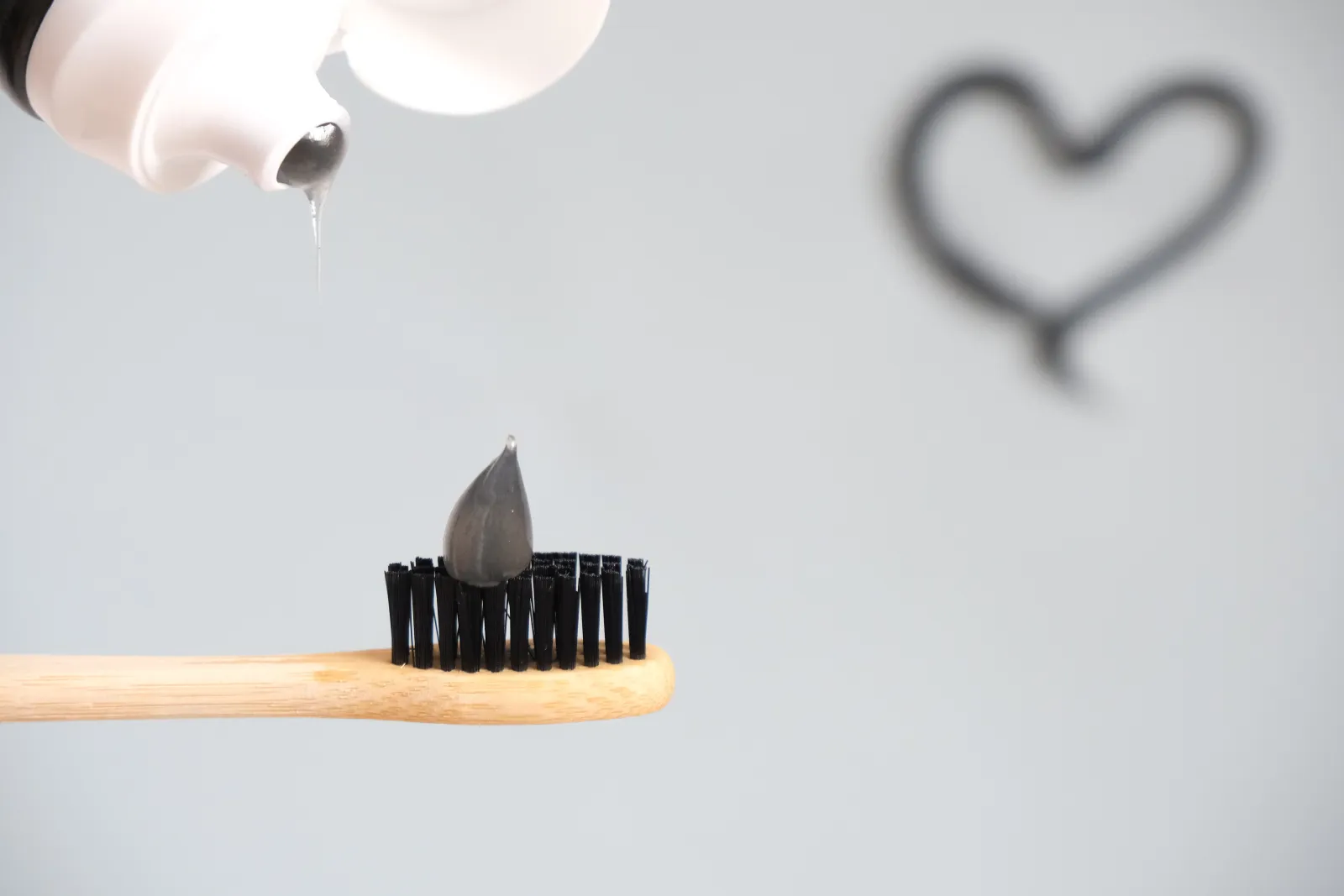
The paste is black, the label promises whiter teeth, and a week of brushing can leave your teeth looking a little cleaner. So it is fair to ask whether charcoal toothpaste teeth whitening is real, or whether the paste is only scratching your teeth. The short answer: charcoal can scrub off some surface stain, but it cannot change the color inside a tooth. Many charcoal products also do not say they contain fluoride. Whether a paste wears your teeth depends on how abrasive it is, how hard you brush, and whether any root is showing.
Where does the color of a tooth come from?
A tooth gets its color from two layers. The outer layer, enamel, is hard and partly see-through. Underneath it sits dentin, which is naturally yellower, and much of the color you see is dentin showing through the enamel.
Coffee, tea, red wine and tobacco leave stain on top, in a thin protein film that coats the enamel. That surface stain is all that scrubbing can reach. The color in the dentin sits behind the enamel, out of reach of grit of any kind.
Can charcoal toothpaste do real teeth whitening?
Not in the sense a dentist means by whitening. Charcoal works on the surface film, where its gritty particles rub stain off as you brush. The American Dental Association describes abrasive whitening toothpastes the same way: they remove surface stain physically.
Activated charcoal is also full of tiny pores, and the marketing says it pulls stain out of your teeth. A charcoal particle can hold on to pigment it touches. It cannot pass through enamel to reach the dentin, so it cannot change the shade of the tooth itself.
The lab evidence fits that picture. In a 2019 study, researchers stained cow teeth with black tea and brushed them by machine. After the first brushing, the charcoal paste had changed nothing. After brushing that simulated four weeks of use, it had lifted some tea stain, about as much as a whitening paste that relies on abrasives. Pastes with peroxide, a blue optical dye or microbeads did better.
A 2017 review in the Journal of the American Dental Association went looking for proof behind charcoal products. It found too little clinical and laboratory data to back up the safety and effectiveness claims made for them. It advised dentists to tell patients to be cautious. One of two charcoal powders tested in a 2020 lab study also contained naphthalene, a chemical the European Union bans from cosmetics.
What does RDA mean on a toothpaste?
RDA stands for relative dentin abrasivity. It is a lab score for how much a paste wears away dentin compared with a reference. The ADA considers any paste at 250 or below safe, and every paste with the ADA Seal must be at or under that line.
The ADA adds two points. A lifetime of proper brushing with a paste in that range causes limited wear to dentin and virtually no wear to enamel. And a score under 250 cannot be used to rank one paste as safer than another.
Charcoal pastes vary. The 2020 study measured its two charcoal powders at 66 and 75, inside the international limit, yet both left dentin rougher than brushing with water. In the same test they were no rougher than a regular whitening paste.
A 2022 study brushed human dentin with three charcoal pastes on electric brushes. One wore away about two and a half times as much dentin as water did. The other two did no worse than water or a regular paste, and the authors concluded the charcoal itself had little effect on wear.
So the word charcoal on a label does not tell you how abrasive a product is. The rest of the formula and the way you brush decide that.
Can charcoal toothpaste make teeth look more yellow?
It can, in two places: a root surface that is showing, and enamel that acid has softened.
When gums pull back, they expose the root, and the root has no enamel. It is dentin under a thin coating, softer and yellower than enamel. A gritty paste and a heavy hand wear it faster, and a worn root can turn sensitive and look darker at the gumline.
Enamel loses a little mineral each time you eat or drink something acidic, then rebuilds as saliva brings minerals back. Scrubbing hard while it is soft takes more of it off. Over years, thinner enamel lets more of the yellow dentin underneath show through, so the tooth looks darker rather than lighter.
Our post on electric and manual toothbrushes explains why how hard you press matters more than which brush you pick.
Why does fluoride matter here?
The ADA says fluoride strengthens teeth and helps enamel repair in the earliest stage of decay. A toothpaste must contain it before the ADA will accept it for preventing cavities.
Charcoal products often do not mention it. When the 2017 review looked at 50 charcoal products sold online, only 8% said they contained fluoride. If a paste without fluoride replaces your regular toothpaste, you give up fluoride twice a day and keep only the scrubbing.
You may also read that charcoal soaks up fluoride. The 2020 study tested that, and its two powders did not. The real problem is simpler: most of the 50 products in the 2017 review did not claim any fluoride to begin with. Our post on what fluoride does to a tooth explains the repair it makes possible.
What actually lightens the color inside a tooth?
Peroxide, the active ingredient in professional whitening gel, breaks down and passes through enamel into the dentin. There it breaks large colored molecules into smaller ones that reflect less color, so the tooth looks lighter without losing any of its surface.
That chemistry only works on natural tooth. Crowns, veneers and tooth-colored fillings keep the shade they were made in. So we examine your teeth and gums before whitening, and we map any restorations in your smile first. At Advanced Dental Care of Stafford, we offer whitening in-office or with take-home trays.
If your stain is only on the surface, a professional cleaning may be enough. It polishes off stain and removes tartar, the hardened plaque a brush cannot shift. That is part of your exam and cleaning visit.
Should you stop using charcoal toothpaste?
That decision is yours. If you like it, choose one with fluoride, use a soft brush with light pressure, and take extra care where your gums have pulled back. If the maker publishes an RDA, it should be 250 or less. Stop if your teeth turn sensitive or you notice a notch forming at the gumline.
If you want to know whether your teeth show wear or exposed root, bring the tube to your next checkup and ask us. You can call Advanced Dental Care of Stafford at (540) 288-2800 or send a message through our contact page.
More from Our Blog
How to Choose a Dentist for Your Dental Implant: Questions Worth Asking
Implant dentistry is not a recognized dental specialty, so a title tells you less than the answers to a few questions. Ask about training, who places the implant and who makes the tooth, how the case is planned, and what happens if it fails.
Read more
Snap-In Dentures or Fixed All-on-4: How to Choose
A snap-in denture clips onto implants and comes out at night, and your gums still carry part of each bite. A fixed All-on-4 arch stays in and rests entirely on its implants.
Read more
What Is a Full-Mouth Restoration? It Isn't Always Implants
A full-mouth restoration does not always mean implants. When your own teeth are worn or broken but their roots are sound, they can be rebuilt with bonding, onlays and crowns, planned around your bite.
Read more